BPRC in De Telegraaf: ‘Science needs us’
The article on BPRC in De Telegraaf offers insight into our work, highlighting animal care, scientific research and the role of monkeys in studies on serious diseases. It also addresses the ethical considerations and broader societal debate, with transparency and necessity at the core of the discussion.

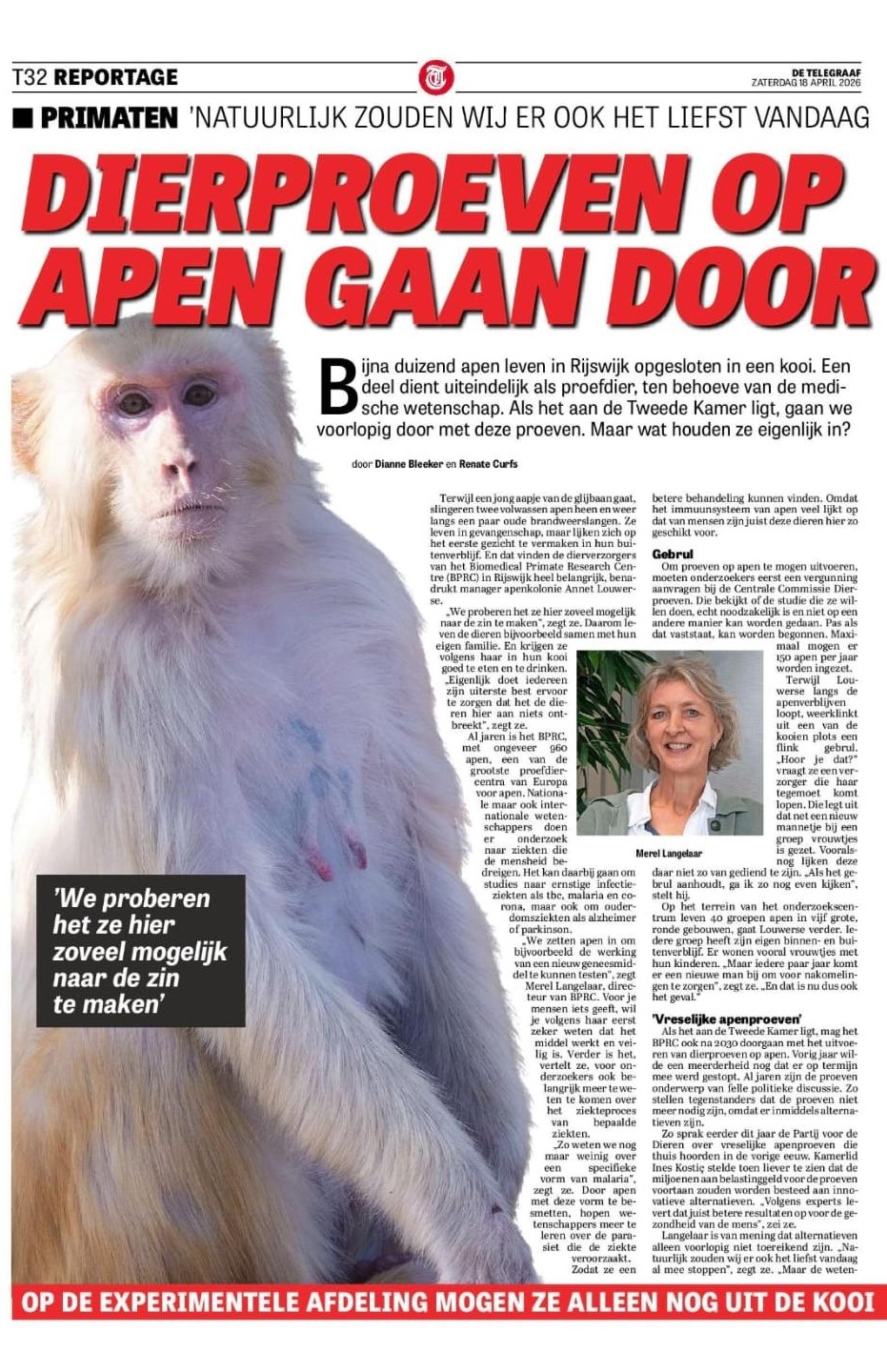
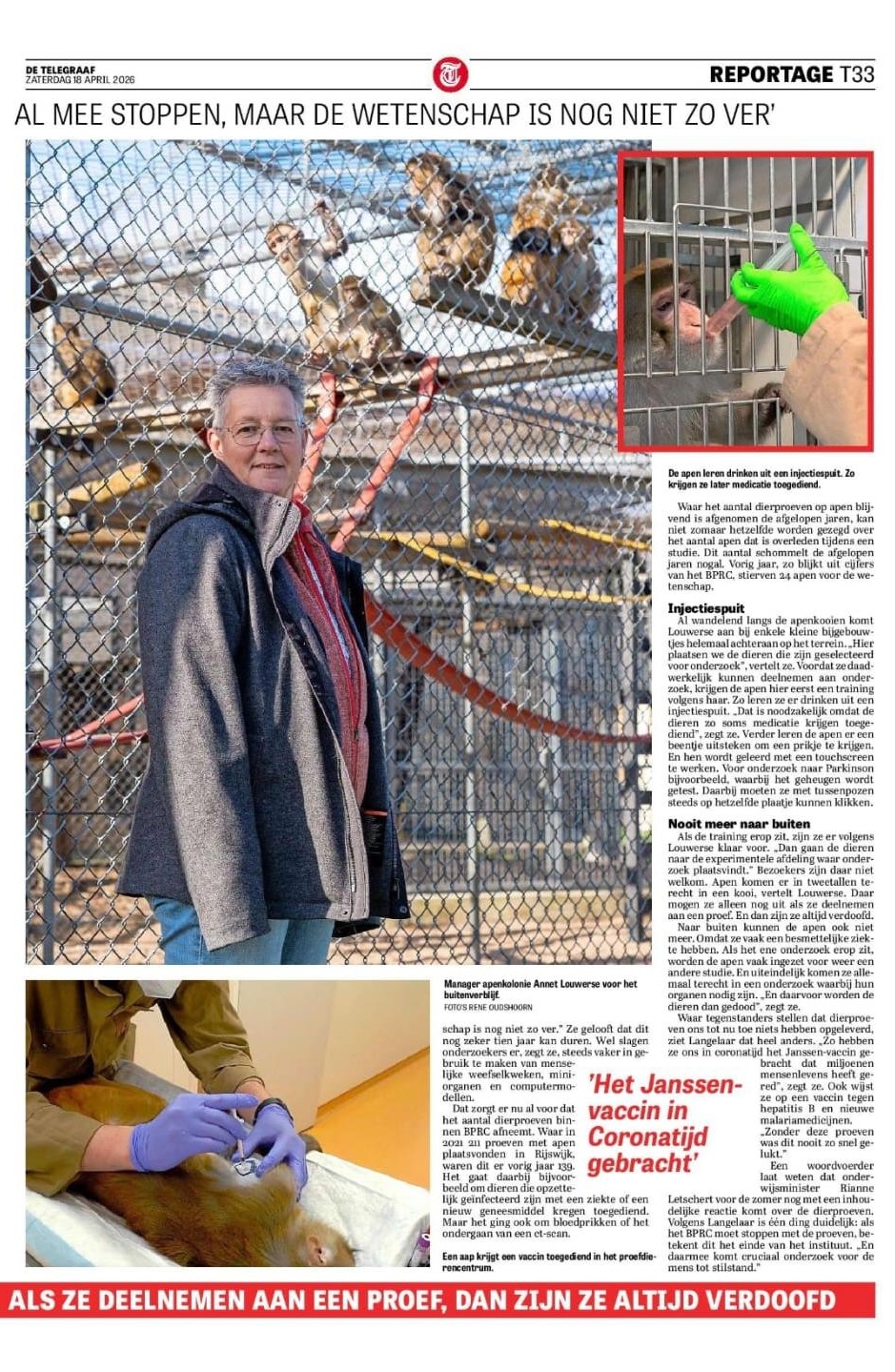
This weekend, De Telegraaf published a major article about BPRC. The journalist aimed to give readers insight into our work in a place that raises many questions and opinions. For that reason, we believe it is important that people can see what we do, why we do it and how we do it.
Read the article here (page 1) and here (page 2), or on the De Telegraaf website.
The article takes readers around the facility, past the enclosures where monkeys live in social family groups. It describes how the animals play, climb and interact, and how animal caretakers work every day to support their wellbeing. Because good research starts with good animal care.
At the same time, the article shows what our work is about: research into diseases that have a major impact on global public health. This includes infectious diseases such as COVID-19, tuberculosis and malaria, as well as complex neurological disorders like Alzheimer’s and Parkinson’s. Researchers aim to understand how these diseases work and how they can be prevented or treated.
We conduct this research in various ways, using computer models, organoids and monkeys, because of their close similarity to humans. The article also addresses the societal and political debate surrounding this work.
We understand that debate. If research can be done without animals, we do it without animals. And this is happening more and more often. But science still needs us. There are many conditions for which alternative research methods do not yet provide sufficient answers.
Consider, for example, understanding a complex immune system or testing a vaccine before it is used in humans. In such cases, research with monkeys may still be necessary to take reliable and safe steps towards clinical application.
The article also makes clear that this research is never carried out lightly. Every study requires approval from the Central Authority for Scientific Procedures on Animals, which strictly assesses necessity, scientific quality and the absence of alternatives.
In addition, we continuously work to reduce the number of animals used in research, and we store tissues, DNA and blood in biobanks that are used by scientists worldwide.
The article highlights how complex and layered this topic is. It is about care and responsibility, about science and progress, and about decisions that are never made lightly.
We do not shy away from this conversation. On the contrary, by showing what we do, we hope to contribute to better understanding. Not because everyone has to agree with us, but because a well informed discussion starts with transparency.