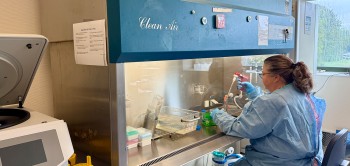
Researcher Claudia explains how a laminar flow cabinet protects both herself and her research when working with biological material.

ParkinsonNederland visited BPRC for an update on research into brain changes after SARS-CoV-2 infection and their possible link to Parkinson’s disease.

The international science platform The Transmitter has published an article about BPRC, the Dutch government's recent decision and the debate surrounding research involving non-human primates.
BPRC researchers investigate what happens in the body and brain after a SARS-CoV-2 infection, helping to piece together the puzzle of Long COVID.

More than thirty years after pioneering HIV research at BPRC, the work is still generating new scientific insights. A new PNAS study shows how HIV may influence the genetic composition of human populations over time.

Researcher Kari-Pekka Skarp explains why methods papers are essential for reliable science. By documenting every step of an experiment in detail, other researchers can reproduce and build on the findings. In this way, laboratory models and open science help accelerate the development of new treatments.

Researcher Magdalena Lorenowicz is working on a promising treatment to reduce complications after stem cell transplantation in children. Using mesenchymal stromal cells (MSCs), she aims to improve survival rates. Innovative laboratory models are helping to pave the way for personalised therapy.

Researcher Gunjan Bawne investigates how viral infections may contribute to Alzheimer's and Parkinson's disease. Using blood analyses, stem cells, and innovative models, she aims to identify early signs of neurodegenerative diseases.

Member of Parliament Wimar Bolhuis of the party Progressief Nederland visited BPRC last Wednesday, 8 July.

Professor Bert Windhorst is developing a PET tracer that enables Parkinson's disease to be detected at an earlier stage. This will allow new treatments to be evaluated more effectively. It brings earlier diagnosis and more effective medicines one step closer.

More than 150 scientists from leading Dutch research institutes and universities are speaking out today during BOARD26 (Be Open About…

Roger Taylor opened the Freddie Mercury Building at BPRC in Rijswijk in 1992 as a tribute to Freddie Mercury. The collaboration with the Mercury Phoenix Trust gave a significant boost to HIV/AIDS research. More than three decades later, the building remains a symbol of the power of science and collaboration.