Minister Letschert visits BPRC
Minister Rianne Letschert visits BPRC ahead of the 15 October parliamentary debate on animal experiments to discuss animal welfare, alternative research methods and research infrastructure.
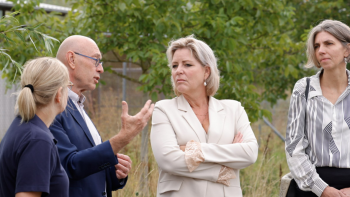
Minister Rianne Letschert of Education, Culture and Science visited BPRC on Thursday. During her visit, she toured the monkey colony and spoke with researchers about alternatives to animal experiments and the importance of preserving the research infrastructure that has been carefully developed over decades. She supports the institute’s ambition to enable more research without animals.
A parliamentary debate on animal experiments is scheduled for 15 October. Rianne Letschert's visit to BPRC was part of her preparations for this debate. She began her visit in the biomedical research institute's advanced laboratories, where she was introduced to organoids: laboratory-grown cell structures that can mimic processes in the body.
New methods are making it possible to conduct more research into diseases and medicines, but as with all scientific research, progress takes time. “We have to appreciate the small steps,” replied Magdalena Lorenowicz, head of the Advanced In Vitro Modelling Systems group, when the minister asked whether she found this difficult to accept.
The minister then visited the monkey colony with Professor Jan Langermans, head of the Animal Sciences Department, and Nelleke Verhave, chair of BPRC's Animal Experiments Committee (DEC).
Jan explained how the animals live in social groups and discussed their housing and enrichment. Nelleke explained how the DEC evaluates research proposals: can the research question be answered in another way, can fewer animals be used, and how can the research methods be further refined?
Nelleke also described the considerations that precede research involving monkeys. Can a research question be answered using another method? Can fewer animals be used? These questions are central to the 3Rs: replacement, reduction and refinement of animal experiments. Veterinarian Annemiek Maaskant discussed the veterinary care provided to the animals and her PhD research into improving animal welfare, including through nutrition.
Being prepared before a crisis occurs
Following the tour, managing director Merel Langelaar gave a presentation on BPRC's research and infrastructure. One of the topics was pandemic preparedness: ensuring that the necessary knowledge, people and facilities are available before a new health crisis emerges.
BPRC also holds a strategic position within Europe. It is one of only two European primate research centres with its own breeding colony of more than 900 monkeys. This colony and the expertise developed over the years provide continuity for research that cannot simply be organised once a new health crisis has already begun.
The COVID-19 pandemic clearly demonstrated the importance of this. When SARS-CoV-2 spread across the world, BPRC already had specialised staff, research models, high-containment facilities and international collaborations in place. This allowed the institute to respond quickly and, among other things, test the efficacy of the Janssen vaccine.
This example particularly resonated with the minister. After all, knowledge and infrastructure that have taken decades to develop cannot simply be established when a new infectious disease emerges.
Malaria researcher Annemarie Voorberg demonstrated how traditional and new research methods are increasingly being combined. For example, 2D and 3D models of monkey liver cells can be used to investigate and select potential medicines. Only after this initial screening does research involving a monkey follow.
Solving the puzzle of long COVID
The importance of combining different research methods becomes particularly clear in long COVID research. Advanced imaging techniques allow researchers to follow the same animal over an extended period. This enables them to observe changes in the body both during an infection and long afterwards.
Imaging specialist Marieke Stammes explained that the same imaging technique is now also being used in patients with long COVID. This provides information that is difficult to obtain from patients alone. For someone who develops long COVID, scans taken before the infection are usually unavailable. In an animal model, however, researchers can follow the disease process from the very beginning. By comparing findings from both types of research, new pieces of the puzzle emerge, helping scientists better understand long COVID.
The COVID-19 pandemic demonstrated how closely infectious diseases and brain health can be connected. Infections can have long-lasting effects on the brain. This is why research into infectious diseases and research into ageing, Parkinson's disease and Alzheimer's disease come together at BPRC.
Jinte Middeldorp, head of the Neurobiology and Ageing Department, discussed research into healthy ageing, as well as the risks of developing Parkinson's and Alzheimer's disease. At BPRC, measurements taken during an animal's lifetime can be linked to biomarkers, brain tissue, biobank samples and historical data.
A collection of organoids is not yet a complete body
Magdalena Lorenowicz demonstrated what is already possible with innovative new research models. However, an organoid is not yet a complete organ, and a collection of organoids does not make up an entire body.
Validating organoids made from human cells plays an important role in this process. By verifying findings from organoid studies of disease processes and medicines in a whole organism, researchers can better predict whether results obtained using human organoids provide sufficient evidence of, for example, the safety and efficacy of a new medicine. They can also assess whether these models provide sufficient insight into a disease as it occurs in the complete human body.
This prompted a fundamental question from the minister: what will BPRC's niche be in the future? Much of the answer lies in combining different approaches. New models are used wherever possible. At the same time, findings from research involving a complete organism can help determine how reliable these new models are.
Exactly what BPRC's scientific niche will be in the future is difficult to predict. Langermans cited organ transplantation as an example. BPRC previously conducted extensive research in this field. That knowledge has since been translated into clinical practice, meaning that this type of research is no longer necessary at BPRC.
Not dismantling infrastructure before alternatives are ready
The minister wants to accelerate this transition. Investing in alternative research methods can make it possible to conduct increasing amounts of research with fewer animals or without animals altogether.
However, she believes this must come with an important condition. She does not consider it responsible to reduce existing research capacity before new methods can provide the same essential information.
For BPRC, these two ambitions go hand in hand: developing and applying new research methods wherever possible, while preserving the knowledge, expertise and infrastructure needed to address research questions involving the complexity of a whole organism, and where evidence of the efficacy and safety of new medicines requires it.
‘That is nothing to be ashamed of’
Towards the end of the visit, the conversation shifted from science to the people carrying out the research. Merel Langelaar explained that some employees still do not dare to tell people around them where they work. Threats against staff members were also discussed.
This affected the minister. During her visit, she had seen the attention devoted to animal welfare, the careful considerations preceding animal research and the way different research methods are combined.
The minister believes it is important for BPRC to be open about what it does, why this type of research is necessary and how it is conducted. “What I have seen here is just how incredibly carefully you carry out your work,” she said.
She was even more emphatic about threats against employees: “I will stand firmly against that.” She also stressed that employees have no reason to feel ashamed of their work. “That is nothing to be ashamed of.”
Ultimately, this is not just about research methods, models or infrastructure, but about people who become ill. About long COVID, infectious diseases, Parkinson's and Alzheimer's disease. About research that, as the minister herself put it, “also helps your child, or your grandmother”.
