‘Research into diseases for which monkeys are needed’
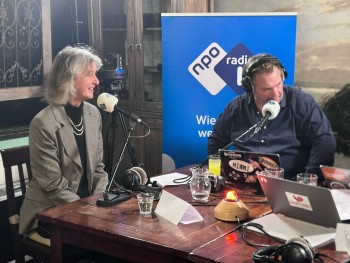
Merel Langelaar, director of the BPRC, was a guest on Sunday evening, 1 March, on the NPO Radio 1 programme Dijkstra & Evenblij ter plekke. In a café in Rijswijk she spoke with presenters Frank Evenblij and Els Knaapen about the work of the research centre and the future of animal research. Also at the table was Jorke Willemse, a researcher working on organoids at Erasmus MC.
The director explained that the BPRC conducts research into serious brain diseases such as Parkinson’s and Alzheimer’s and infectious diseases such as influenza, COVID-19 and HIV. In some of these studies, non-human primates are used.
Around one thousand macaques live on the premises: rhesus macaques and long-tailed macaques, all of which were born at the centre. The monkeys live in social family groups, with parents, brothers, sisters and other relatives in spacious enclosures with extensive opportunities to play and climb.
Only when they are at least four years old can they be involved in research. This happens only in studies for which no alternative research methods are available. “We do not have monkeys in order to do research with monkeys”, Langelaar says. “We conduct research into diseases for which monkeys are sometimes needed.”
Is phasing out within five years feasible?
A majority in parliament believes that animal experiments should be phased out and that the subsidy can disappear within five years. According to Jorke Willemse, that timeframe is not realistic. “Developments are moving quickly and our toolbox is expanding all the time. However, we are not yet far enough to replicate the complex interactions within a complete body without the use of animals.”
The researcher works with organoids: three-dimensional mini-organs grown in the laboratory. The original idea was to create fully transplantable livers to address the shortage of donor organs. “That has not yet succeeded. However, organoids do allow us to replicate disease processes more accurately and to pre-test medicines.”
Animal research as a final step
Since its establishment, the BPRC has worked according to the three Rs: replacement, reduction and refinement. A great deal of work is also done with cell cultures, computer models and organoids. However, alternatives have their limits. “What cannot be studied with an organoid is the complex interaction between different organs and tissues within one body”, Jorke Willemse says. “It is not possible to attach a concrete timeline to that.”
Critics argue that the translation from monkey to human often falls short. Merel Langelaar understands that concern, but points out that primates closely resemble humans and develop similar diseases. “Their immune system responds in a comparable way. For that reason, primates are still widely used in research worldwide.” According to her, primate research also helps to validate new human models. “If you test a medicine in a human mini-organ, you do not want to move directly to patients without additional certainty.”
Survey
A survey among 270 Dutch researchers shows that more than 80 percent indicate that primates are necessary for their type of research. More than 90 percent expect no change in that situation in the coming five years.
What would happen if the subsidy stops? According to Langelaar, phasing out the subsidy would have major consequences. “Then we would have a serious problem, and especially our animals. You do not want to reduce spending on their care. And if research stops here, that does not mean it stops worldwide. It will move to countries with lower welfare standards.”
Researcher Jorke Willemse hopes that animal experiments will eventually no longer be necessary. “However, that requires intensive collaboration and continued investment in alternatives. With shared knowledge we can achieve a great deal.” The full conversation can be listened to and watched via this link.
