Two little hearts in one belly and now together in the spring sun
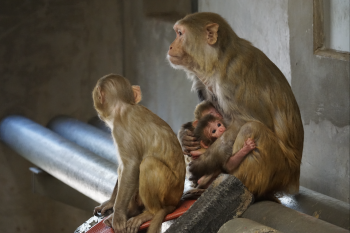
It is International Macaque Week. And this year at BPRC it begins with something special: new life all around you and a rare surprise. The birth of twins among the rhesus macaques.
A baby monkey of a few months old carefully climbs onto a beam. Still a bit unsteady, but determined. At the top he sits down, right next to his slightly bigger sister. A little further on, their mother and an aunt – the aunt with a young one held against her – watch calmly, bathed in the spring sun. It is one of those moments where everything comes together: calm, curiosity and new life.
The birth season in the monkey colony is in full swing. More than thirty babies have already been born, and regularly another one is added, animal caretaker Sacha explains. Everywhere you see mothers with young: tightly clutched to the chest in the first weeks, later more loosely, playing, exploring and sometimes already surprisingly independent.
But this year there is something that really stands out. We turn the clock back a few weeks. During the annual health check, veterinarian Merel moves the head of the ultrasound device over the belly of the heavily pregnant rhesus macaque Patricia.
On the screen something appears that you rarely see. She frowns for a moment, looks again carefully and then calls the animal caretakers over: “Come and have a look… we have twins.”
Twins in rhesus macaques are exceptional, the veterinarian explains. Their gestation period is about five and a half months and almost always one infant is born. The chance of twins is around one in a thousand. And that is only the beginning: the chance that both infants survive is even smaller. Even for experienced animal caretakers like Sacha it is special. In 25 years it has only happened a few times that a monkey twin was born.
Then we move forward in time again. The twins have now been born. And against all expectations, things are going well. In fact, they are going very well.
Animal caretaker Sacha walks along the enclosures with her camera, looking for Patricia. She proudly carries her two young with her, although she does not show herself today. “She is sometimes a bit shy,” Sacha notes, although she has already had her in front of the camera. And in the photo you can clearly see it: one baby is drinking at its mother’s breast, while the other looks around curiously.
The signs are clear, colony manager Annet also confirms: the young are strong, alert and developing well. “We just do not yet know their sex. So they will get a name later.”
Meanwhile, life in the monkey family group continues as usual. Mothers protect their young, but also give them space. Sometimes you see a young one already running around while the mother is still hesitating. Sometimes she even briefly holds the tail as a kind of safety line. Other group members watch, sometimes lend a hand. It is a social world, in which learning and growing up happen together.
And right now, in spring, you see that best. Movement everywhere. New life everywhere. And somewhere in between: two young rhesus macaques growing up together, against all expectations.
That makes this International Macaque Week just a bit different. Not only a moment to reflect on these animals and their role in research. But also to see how special their lives themselves are. Sometimes it is in something big. And sometimes in two small hearts that started beating at the same time.
